Sunday, March 29, 2026

Blog Post #7

Topic: BRIDGE BUILDING

Bridging our Big Picture into your own contexts


Resource: (Magazine Website): "Rethinking Schools"

Link: https://rethinkingschools.org/archive/


Article Researched: "We Are All MinneapolisSchools and Teachers on the Frontlines of Fighting Fascism"


Link: https://rethinkingschools.org/articles/we-are-all-minneapolis/


Beginning of Text (Introduction): The article from "Rethinking Our Schools" titled "We Are All Minneapolis" starts off by mentioning that over 3,000 ICE agents were deployed to the Minneapolis, Minnesota area in January of this year. From the text: "As 2026 began, the Department of Homeland Security launched Operation Metro Surge, deploying more than 3,000 federal immigration agents to the Minneapolis–Saint Paul metropolitan area — triple the size of both cities’ police forces." The introduction continues that this incident has triggered the rise of anti-facism in the United States. This section continues that "Columbia Heights Public Schools, a small suburban school district just north of Minneapolis that serves a student population of 3,400 — around half of whom are Latinx — has shouldered a disproportionate impact of the surge."


Middle of Text: This reading continues that a day before Renee Good was famously murdered on camera by ICE while in her SUV, a 10 year old girl and her mother were detained by ICE. The girl called her father to tell him that ICE was giving her a ride to school. In reality, this girl and her Mom were deported to a detention facility in Texas. Her Dad was expectedly devastated. The 5 year old in the above image with the bunny hat, was also picked up by ICE, along with his Dad. His brother came home to find both of them missing. The school principals rushed to the brothers home to try to offer him support. 


A few days after the nurse, Alex Pretti, was also killed on video by ICE, a mother was abducted by ICE. Her 2 boys were also sent to a detention facility. “We had to deliver them to a detention center,” said Jason Kuhlman, the Valley View Elementary principal. “[For ICE] to put us in a position like that, I don’t have words. I mean, the frustration, the anger, it’s overwhelming.” According to Kuhlman, the boys cried when he explained what was happening and asked the school nurse to hold their hands while bringing them into the federal building. 


These continued incidents are devastating to communities, and young children don't often understand. Schools are put in very difficult situations. These policies by the Federal Government and ICE are not humane, and causes high levels of stress and anxiety with the general population, not to mention to families of color. This section continues that "As the abductions became more frequent, many students and parents began to stay home out of fear. In some Minneapolis-area schools attendance plummeted below 50 percent." “Students used to ask me for help navigating friendships,” Xiong told the New York Times. “Now they ask me how to cope with ICE breaking apart their families and taking their friends.”


End of Text (Conclusion): 

Families detained by ICE in Minnesota are sent over 1,000 miles away to a detention center outside San Antonio, Texas. From the article: "Detained families have reported undrinkable water, inedible food — sometimes with worms or mold, showers with soap that cause rashes, delayed medical care, and being forced to sleep with the lights on 24 hours a day." This is unacceptable, unethical, and inhumane.


In response, schools and teachers have been part of the resistance. As Jey Ehrenhalt writes"Minneapolis Families for Public Schools quickly created rapid-response groups. These volunteer-organized teams of parents and community members began monitoring federal agency activity near schools. They coordinated community support and alerts to protect students, families, and staff. Leaders borrowed tactics from similar efforts in Chicago. Coordinators circulated a Google Form allowing families to request help anonymously with groceries, rides, rent relief, and other necessities while sheltering in place. Once the foundation of support proved solid, more neighbors began carrying whistles and patrolling city streets. They also kept watch during key times, such as school recess and arrival and dismissal."


Neighborhoods stepped up, acting as community watch groups by alerting others when ICE was spotted in their area. The article also mentions how teachers' unions got involved with support. School staff also started delivering food to families who were afraid to leave their home. 


On January 30th, Minnesota inspired a nation for students to walk out of school and their classes in protest against ICE and their fascist actions. From the article: "Minnesota inspired the nation. The call for a nationwide shutdown on Jan. 30 gained traction. That day thousands of students walked out of classes in Atlanta, Austin, Portland, Knoxville, Milwaukee, New York City, Salt Lake City, Tucson, and other areas throughout the country." We also did this in Rhode Island.


Argument Statement:

The Rethinking Schools editorial "We Are All Minneapolis" argues that social justice unionism and organized collective resistance are necessary for educators to counter rising authoritarianism and protect communities. The piece advocates for building broad coalitions, teaching labor and immigrant history, and rejecting neutrality in favor of active, politicized teaching.


(Note: I used A.I. in order to research the main argument of this article in further depth with a prompt).


Additional Personal Thoughts, Connections, and Reflections:

  • This article not only ties into what we have covered in this Graduation Education Class: Social Issues in Education, it also ties into my Teach Out Project where I also discussed ICE and their presence in Minneapolis, Minnesota, and the impact to students and schools.
  • I have been to Minneapolis to visit family when I was 10 years old. My uncle worked for one of the small aircraft companies there. I remember that it is a clean city. I actually recall seeing the movie "Airplane!" in the movies there!
  • My school, Highlander Charter School, had a lock down for approximately one hour last fall during last period, as there were reports that ICE was in the neighborhood.  The 7-12 grade campus is in Warren on the Massachusetts line, however, our lower school (K-6) is located in downtown Providence. We didn't know at the time whether ICE was in the Warren neighborhood or Providence. Our school had administrators walk students to our buses one bus at a time, keeping an eye out for ICE. Apparently, ICE was in the Providence neighborhood, next to the lower campus school, and in their highly Hispanic neighborhood, causing anxiety with students and families. Our buses were diverted from going to the lower campus in Providence as well as Kennedy Plaza due to this threat of detaining students.
  • This article about ICE in Minneapolis also mentions that there were student protests against this Federal Administration and ICE. There was also a coordinated "walk out' in Providence where our students did a "walk-out" during the last period of the day. At 1pm on a Friday, many students did a silent walk-out around the school with signs showing support for students, including students of color which many of our students are, for approximately 30 minutes. My entire Geometry class participated in this show of support and consolidarity.
  • This article also ties into other texts that we have read and blogged about during this graduate class, including the themes of power and privilege, cultural discrimination, and the broken model.
Technology, Links, Other Texts, References, and Additional Connections:
(Note: I used A.I. to create some of the hyperlinks automatically, through the Bloggerapplication.)


Sunday, March 22, 2026

Teach Out Project Proposal


The Teach Out Project


CHOOSE A TEXT:

Review your whole blog to remind yourself about what we have read so far in class. What texts have stayed with you so far? What articles inspire you?  What topic matters most to you in terms of your own work? Are there any of these texts that you would like to share with others in your life? 


The articles/ texts that are most interesting to me are Lisa Delpit’s “Other People’s Children: Cultural Conflict in the Classroom” (Blog Post 5) and “Shifting the Paradigm” (Blog Post #4). 


With “Shifting the Paradigm”, this is about building up student assets, and having a growth mindset, instead of a deficit mindset. With an asset model, schools need to build up students by focusing on positive attributes. Student growth needs to be prioritized. In my blog, I mention how I have seen this in the charter school that I work at, and other schools. Leadership also needs to model this behavior. This article details that while focusing on deficits may work in business (which I partly disagree with), this does not work in education. By focusing on what students can do, versus what they cannot do, schools will achieve better results.


The other reading that most relates to my interest is “Other People’s Children”. Although I dislike the term “White Savior” as I mention in my blog, as a white teacher is an urban school, with a large majority of students being of color, including a large MLL population, this impacts me because although I am aware of some cultural biases and differences, there are some that I may not be. I mention this as one of the reasons that I made a career change almost 14 years ago from business to education, is that volunteered in a rural school in a small village in Western Kenya, Africa, and felt a connection to teaching and helping students, and was encouraged by my children’s Middle School Principal, who also went on this trip, to pursue teaching. The students in Kenya were of color. When I returned to Massachusetts, I applied and got hired as a building substitute teacher by Fall River Public Schools, an urban school district, which I began working for within 3 months. This article states that there is a “Culture of Power”, which may not even be realized by white teachers, and that there is an imbalance because of this. People with the most power may actually realize this the least. A main argument of this reading is that students of color are impacted negatively by cultural miscommunication, in addition to power imbalances between white teachers and minority students. The article states that direct communication is better than indirect communication with students of color, which is something as a teacher, to be aware of.


These two particular articles stand out most to me. With “Other People’s Children”, although I am aware of some of the privileges that I have as a teacher, I didn’t always think of this in terms of race. I also have previously thought that since I am not racist, I am not part of the problem, however, with more teaching experience and with these readings and discussion in class, I see that I am in a bigger position of power than I may have realized, besides being the teacher. 


Are there people in your life with whom you would really like to talk about these texts? Colleagues? Students? Family members? Friends? Children?


With the Asset Model, I am a strong proponent of focusing on the positives instead of negatives in my teaching practice, although in my personal life, I can focus on the negative aspects too much sometimes. In talking with my 22 year old son regarding his first job that he recently started relating to his Communications/ Media degree, my wife and I have told him to focus on the positives, as this is his first “corporate job”, having previously been a college student and working in restaurants. We have told him to focus on the positive aspects of this job, although this role of working in an office isn’t really what he wants to do. On the other hand, we tell him he should follow his dreams, especially at 22 years old. The article that I would like to share with him is the “Shifting the Paradigm” article as it focuses on assets and growth instead of deficits. The transition from college student to working in a cubicle is challenging. My son also was a junior and senior in High School during Covid, and lost most of these years by doing work at home. I suspect this has something to do with this transition being challenging as he needs to work remotely from home 2 days per week. I just told my son to use his strengths as I just briefly discussed this with him. Use your creativity strengths. Don’t be a robot.


I also have done some of what we have done in this class with my evening class on Mondays, where I am teaching a History/ Social Issues class, which is a Community Evening High School degree program at Somerset Berkley Regional High School in Somerset, Massachusetts. One thing that I have shared with my students is the Bad Bunny controversy with the Super Bowl halftime show, along with the issues going on with ICE including in Minnesota. As we did in class, I asked students to rate where they stood on the issue of ICE, and whether they agree with what is happening, from a rate of 10 (100% support) to 0 (don’t support). Then we did a debate style of why did they rate it this way. We also did this with Bad Bunny, and watched the show in class for those that hadn’t seen it. I also shared additional articles that I located involving these controversies, and shared with my class, and asked each to write a reflection on this, including the derogatory comments that President Trump stated immediately after Bad Bunny’s performance.


WHAT FORMAT MIGHT WORK FOR YOU?

Individual interview? Small group discussion? Art activity? Professional development workshop? Poster for your office? Pamphlet to share? Lesson plan? Etc?


My evening class will be my Teach Out Project. I did not expect to teach a “World History” class this semester, as I usually teach math. Since this class started about the same time as this Social Issues in Education class, I have been incorporating elements of this class with my High School evening class, which is primarily 16 to 18 year old students obtaining credits to obtain their high school diploma. I have already created materials to use in this class, which I will be sharing as part of my project. I am creating materials, and also just had students do their own research project where they selected a social issue/ history topic, and made their Google Slides for discussion. I suggested topics relating to social issues / history including ICE Policies and Actions, Politics and Government, The US/ Iran War including the timeline of our relations, Education, The Homeless, and Health Care. Students can also select a topic of their choosing within the parameters of Social Issues and History. One group selected the impact of the U.S./ Iran War and how this affects climate change. Along with Google Slides, in my Teach Out Project I will selectively share assignments that I have created for this class, along with some student work. I even used A.I. to create questions on an assignment from an article on the impact of Social Media on teen’s mental health, that I will be assigning over the next couple of classes. 


To empower students with their interests and skills, I will utilize Google Slides, podcasts, videos, current events, and history including their personal interests (for example, Colonial America and the native lands that we are on and how this ties to current day social issues including immigration). Keeping in mind an asset model ties to the texts of “Shifting the Paradigm”, “Other People’s Children”, “The Broken Model”, and others. These students may have “dropped out of day school”, but they should be exposed to a high level educational opportunity, so I am bringing elements of our graduate Social Issues in Education class to them. Students appreciate the opportunity to do their own research which engages them to be more dedicated to their own learning and success. These students will be getting a regular high school diploma when they complete this program. 


Saturday, March 14, 2026

Blog Post #6


Topic: Sex and Gender-based Systems

Policies: RI Laws and Policies; and PPSD Policy

ArticleQueering Our Schools (Does your school or org have a policy?)


Beginning of Text (Introduction): The beginning of the text "Queering Our Schools", by the editors of Rethinking Schools, starts off with that in 2013, the state of Illinois became the 16th state to legalize same sex-marriage. Certainly some things have changed since 2026. In Oakland High School in 2013, a student named Sasha, an agender youth, had their skirt set on fire by a 16 year old student from other school. This student was charged with 2 felony hates crimes as an adult. Fundraising was done including a "Stroll for Sasha", while Sasha's family stressed education and asked that the student be tried as a child. Sasha's dad is also an educator, teaching at an elementary school, and wrote a letter suggesting how to talk to students. The question is "How do we create classrooms and schools where each child, parent, and staff member's unique, beautiful self is appreciated and nurtured?"

Middle of Text: The next section continues how to build community. Per the article, "Despite the recent advanced in LGBTQ rights, most schools aren't safe for queer students". The article continues that 49 states have passed "anti-bullying" legislation, but it suggests that this isn't enough as there are critical issues that underline these conflicts. It states that teachers "worry about backlash from parents". I recall in working in different schools as a teacher, that we are asked to not use a child's preferred name and gender, in cases where they don't want their families to know. This puts stress on the students and teachers. My school gives out a state issued survey every year around this time called Survey Works, which is an anonymous survey given to school staff, teachers, and students. One of the questions is regarding how comfortable with these issues, including sexual orientation, gender, and harassment, and if you are comfortable with talking to students about these issues. They ask you to rate your comfortability. The article mentions that talking about these issues is "trickier than geometry." As a high school math teacher, I agree. It is easier to teach geometry proofs, which isn't easy either.

End of Text:

This reading continues by mentioning community and empathy, and that school structures should support all families. Examples provided include having "forms that ask for information for Parent/ Family Members instead of Mother and Father" and other ideas, including having gender neutral bathrooms available for everyone. It also mentions the importance of empowering students to participate including in school and in the community to fight for all kinds of social justice. Another point raised in the article is introducing curriculum to integrate not only the history and lives of people of color, but also with LGBTQ students. This reading also ties into the "Being There For Nonbinary Youth" that we were provided, as the high school principal provided a gender-neutral restroom for Eli to use at school, even though in Eli's words "I would not have thought that my principal would have been helpful because he drives a big red truck with a gun rack on it.". Stereotypes are firmly entrenched in our society. Even though the principal may not have fully understood transgender "stuff", he understood enough to provide the student support that "he's entitled to". Also from this related reading, it stresses the importance that "Transgender youth are looking, first, and foremost, for adults to respect their chosen names and pronouns".

Argument Statement: The central argument of this text includes that schools need change their curriculum, culture, and policies besides just having anti-bullying procedures, in order to truly support diverse gender and sexual identities as part of equity and social justice.

(Note: I used A.I. in order to research this article in further depth).

Additional Personal Thoughts, Connections, and Reflections:

Reading this article about a transgender youth reminds me of when I teaching high school math one year at Attleboro High School. I had a student in my Advisory who went by a traditional male name, but was on the roster as a female name. I certainly made a point of saying their preferred name, including when I did attendance in the morning, however, one morning I accidently said the name as written on the on-line roster. I recall that this student didn't say anything, but stared at me. 

In the charter school that that I have worked at for 4 years, I have noticed that there are actually less transgender students, at least outwardly so, then there were a few years ago. The school that I work at is in Warren, however, most students are bussed in from Providence and greater Providence, including Pawtucket. We also have a large Hispanic culture. I am not sure if this also has something to do with this (video attached below regarding Hispanic culture), or if is also part of what is going on in the United States, with the rolling back of transgender and LBGTQ rights under the current presidential administration. In my opinion, we are going backward. A friend of my son while in high school experienced a situation where he wanted to be called a typically feminine name instead of his Hispanic male name. My son told him that his greater family was against this, and he could not tell his aunt. This was around 8 years ago now, as my son's friend is around 22 years old. In their culture, this was not deemed acceptable.

My school, Highlander Charter School does have a handbook with a policy under Harassment (I have a screenshot of this section here,). Harassment due to perceived sexual orientation and gender are listed.


This article ties into other readings that we have done in class with biases against students, whether it's implicit bias or not. Even if you are not aware of bias, it may be there. Tying into this week's reading, there may be an underlining bias towards transgender students even if you don't think that you have one, based on the culture that is in place. Students should be able to use the gender bathroom of their choice but the school may face backlash if this is known among students' families and the greater community. 

In searching for related videos for this topic to attach to this blog, and I found that a YouTube video from a New York Times piece  regarding voice tone (image attached below) that is not approved as a video to show by my school's IT department ("Who Sounds Gay?"). I am wondering if that is intentional, or just blocked because of the word "Gay"? It is educational.

Technology, Links, Other Texts, References, and Additional Connections:(Note: I used A.I. to create some of the hyperlinks automatically, through the Bloggerapplication.)

https://panthernow.com/2015/02/11/homophobia-in-hispanic-culture/

Hispanic Cultures and Homophobia

https://www.youtube.com/watch?v=XNS3Lc4u0TQ

Stroll for Sasha and Restorative Justice

Optional Reading:https://archive.learningforjustice.org/magazine/summer-2016/being-there-for-nonbinary-youth


Sunday, March 1, 2026

Blog Post #5


Big Picture:

The Culture of Power

A House of Cards

Author:  Lisa Delpit, "Other People's Children: Cultural Conflict in the Classroom"

 Delpit, “The Silenced Dialogue”

Additional Resource: overview handout

Talking Points:

(Beginning of Text)

This week's reading by Lisa Delpit begins by relaying the experience of "a black male graduate student who is also a special education teacher in a predominantly black community talking about his experiences in predominately white university classes". He states that he is "tired of arguing with white people, because they won't listen." Or maybe "they just don't believe you". A Black woman also states "how they should organize reading instruction to best serve students of color." According to this teacher, she argues that her white teachers "think they know what's best for everybody, for everybody's children." which makes her very frustrated. (Note: this reading is from 1995, so over 30 years ago). The reading also mentions a Native Alaskan women who is also a student, and a Black woman principal, who is also a doctoral student. The principal implies that she is also frustrated because when she tries to challenge her professor when lecturing on issues concerning black children, the professor gets defensive and recites research, and ignores this black principal's perspective that this isn't the way that it really is even though that is her experience. She states that "they only want to go on research they've read that other white people have written." This ties into the part of the title of the text: "The Silenced Dialogue". This section continues that not only that these scenarios have been "enacted daily around the country.... The saddest element is that the individuals that the black and Native Alaskan educators speak of in these statements are seldom aware that the dialogue has been silenced." I understand how this can be so frustrating. They lived it. If someone told me as a "white" teacher that I don't know what I am talking about, even though this is my personal experience, I would be frustrated or even mad also. The beginning of this reading continues with "the estrangement that I and many teachers of color feel from the progressive movement when writing process advocates dismiss us as too 'skills oriented', and that they may now share their enthusiasm about so-called new liberal, or progressive ideas". (Note, again, keep in context that this article is from 30 years ago. I wonder what, if much, has changed since?)

(Middle of Text)

The next section of the text continues with the concerns to the author's article "Skills and Other Dilemmas." What I find interesting is that I located a keynote speech by the author, Lisa Delpit, that I attached the link for, where she speaks in 2012. She mentions in her 2012 speech that "black students do not multiply. They add or subtract." As a math teacher, I find this concept interesting. I know that many students do use repeated addition instead of multiplication as I have seen this from my own experience in teaching math to Middle School and High School students. I also find it interesting that the author delivers this speech in 2012, and mentions African American students, when I went to Africa in 2012 to volunteer at a rural school in Kenya, that I detail in my personal thoughts section in this blog. Delpit suggests that the differing perspectives on the debate over "skills" verses "process"  approaches can lead to an understanding of the alienation and miscommunication, and thereby to an understanding of the "silenced dialogue". This way of thinking also makes me think of last week's reading regarding having a deficit or asset based approach, where I used a reference that a former manager of mine when I worked in the financial industry in investment operations, stated that usually isn't the "people" but instead is the "system" or process that's in place. Whether it's employees or students, flaws are often in the procedures and frameworks that are in place. We feel this as teachers also. The school gets pressure from the state, so the administration puts pressure on the teachers, who in turn put pressure on the students. All in the name of "growth". You can see an example of this during last week's blizzard. My school, along with many schools in both Rhode Island and Massachusetts, were closed all week. My school superintendent sent us an emailed survey to ask what we preferred if RIDE doesn't grant us a waiver for the 2 days where the RI governor declared a state of emergency. This puts stress on everyone. Some of my students were continuing to do work online. I know this as they messaged me if I could update their grades. I set this up prior because I tell my students to please just send me a Google chat if you have made up work outside of school, and that you'd like me to update your grade now in Skyward, our online grading system, so they do not have to wait until school resumes. I try to avoid this "silenced dialogue" mentioned by the author with open and transparent communication with my students.

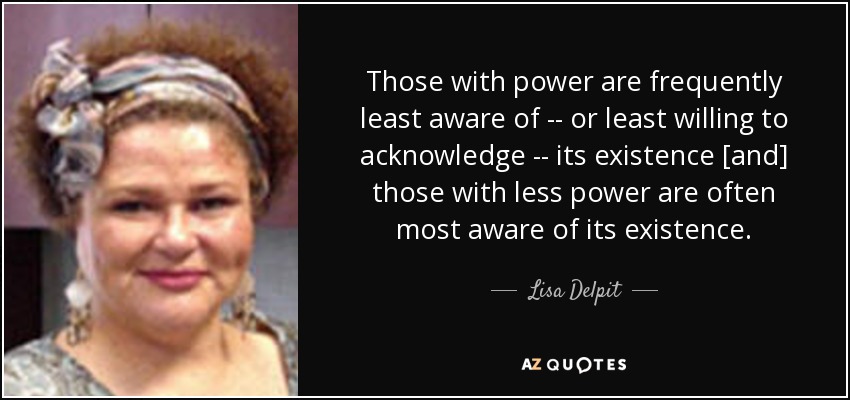
"The Culture of Power" is a main theme of the author's reading. What stood out to me is her point #5: "Those with power are frequently least aware of- or least willing to acknowledge- its existence. Those with less power are often more aware of its existence. " This is interesting to me, as when I first started teaching, I wondered why students misbehaved as I was the one who gave them their grades. I did think that I was in a position of power. I think that I may have even said this to a few students out of frustration when I didn't have as much teaching experience as I do today. I would not say this today. The author does state that this point has "seldom been addressed." I do agree with the text with "the power of the state in enforcing compulsory schooling." It is interesting how the author refers to "progressives" and "liberals" when making her points, including her quote that liberals "seem to act under the assumption that to make any rules or expectations is to act against liberal principles."
(End of Text)

A point that the author makes in the later part of the reading is with indirect communication. She states that direct communication is better. A provided example is with the East Indian interviewee, verses what you might say to a 10 year old to "turn the radio down". I find an interesting point is how the author states that a poor parent may say to a teacher, in response to when a teacher may be questioning the parenting, is "that's the school's job". The author states that if these parents were in a position of power, that they would in fact transmit these "codes" to their children. This is a classic example of when teachers are frustrated that they have no or limited response from a student's family, for example in a case when a teacher is trying to inform a parent about a student's continued misbehavior or disengagement in class, and a parent's response is that it is somehow the school's or the teacher's fault. Part of this may be a defense mechanism, but perhaps it is rooted deeper than this. The parents feel that they have limited power. The teachers feel that the parents should do a "better job" with parenting. This is a circle that I assume many teachers feel. The author quotes that child centered approaches are needed.  I do agree with this philosophy, we tend to call it student centered in school. Delpit continues to provide an example of a doctoral student who was frustrated by their professor's approach in that they wanted the students to read and grade each other's papers as part of a writing course. This doctoral student stated that they weren't learning anything, and were there to learn from the teacher. I have heard this argument from students in my math classes on occasion. When redirected or told the student that they need to complete work, a reply may be something like "you haven't taught anything". As a teacher, this reply can cause a bad reaction. Sometimes I may try to remind the student that I did teach and provide notes on this. Or a better reaction that I have tried is something like, "Well, let's go over this now", which may bring the emotion out of the situation and be more effective. It is enlightening that this "process approach" utilized by teachers may appear to students as "doing nothing" and not teaching, as mentioned in this week's reading. The author states that the teacher should not be the only "expert" in the classroom. Per the author, "to deny students their own expert knowledge is to disempower them". This section continues that in an example of the primarily process-oriented writing class for black students, E.V. Siddle found that the intervention that produced the most positive changes in the students' writing was a '"mini-lesson" consisting of direct instruction, however, the second highest number of positive changes was a subsequent student-centered conference with the teacher. Delpit continues with the argument that black teachers are more direct with their instructions, for example, they will tell students to "Put those scissors on the shelf" verses questions by the "middle-class townspeople" teachers, such as asking "Is this where the scissors belong?". I know I have used this style in my classes, and as a parent, use both styles. The author continues that Middle-class parents are likely to give the directive to a child to take his bath as "Isn't it time for your bath?". This is understand by both the parent and child that this is actually a directive. Asking questions is also a method is sales. I am not sure if the author has done research on this or not. I have been in sales, including in insurance sales. Part of the training in sales is instead of asking a prospect if they want to meet for an appointment, to ask them what time works better for them, and to give them 2 choices ("Would 4 or 7pm work better for you?). I also see this in Facebook Reels where a car dealer's F&I salesperson asks questions to the prospect when trying to sell them an extended warranty, particularly when handling objections. The difference here is that the salesperson may ask the customer if they can ask them a question prior to proceeding ("May I ask you a question?). As a teacher transitioning from working in business and finance, particular after working in insurance sales from 2011 - 2012, I use questioning techniques as a teacher, in order to better engage my students, which is also a classroom management tool. The author continues that "Some members of middle-class cultures, by contrast, expect one to achieve authority of an authoritative role: The teacher is the authority because she is the teacher.". I agree with this premise, especially for newer teachers, until you realize as a teacher that sometimes in addition to being more direct (the "warm firm" approach), you  also need to be able to influence your audience, the students. This correlates to what is provided in the reading, as a complaint of a black male student that the teacher couldn't "control the class". The reading concludes "that students must be taught the codes needed to participate fully in the mainstream of American life...and about the power relationships they represent". The author herself points out that she has been reminded by many teachers, that the most skillful at educating black and poor children, need to have both the "skills", and "process" approaches, which I also state in this blog that I do.

Argument Statement:

The main argument of this reading is that the struggle of academic students of color are often caused by cultural miscommunication, and not lack of ability, due to the power imbalances between predominately white teachers and minority students. It explores that dynamics between power, race, and cultural miscommunication that impacts students of color. 

(A.I. Prompt: Other People's Children: Cultural Conflict in the Classroom)


Additional Personal Thoughts, Connections, and Reflections:

The main argument of the reading with that students of color are impacted negatively by cultural miscommunication, along with power imbalances between white teachers and minority students, hits home with me, since I am a white teacher with a large percentage of minority students. In one of the previous charter schools that I worked at City on a Hill in New Bedford, MA (which no longer exists), the "CEO" of the charter network, who is Black, told us once at an orientation that we shouldn't try to be "White Saviors" as teachers. I recall that I wasn't sure how to take this comment. I and others didn't get into teaching to be "saviors". In fact, I got into teaching in 2012, after working in an insurance sales job that I did not only find not fulfilling, I felt stress and anxiety as I was on a commission only structure, so if I didn't sell, I didn't make any money that week. During August 2012, my family and I went on a 10 day mission to volunteer at a rural school in a village in Amagaro, Kenya, that was approximately 7 miles from the Uganda border, near Mount Elgon. We did this as a partnership between my church, Church of Our Saviour in Somerset, MA, and North Elementary School also in Somerset, where my sons attended at the time, and with our connections in Kenya. We fundraised and volunteered. I had never taught before, but was leading small groups in Kenya with my oldest son who was going into the 6th grade at the time, and I was asked to lead a group of students outside. We started out with our introductions, and since they knew English (they were generally around my sons age so between 10 and 12), we could communicate in English, as they learn English in school, and also Swahili and their local dialect. They also taught us some words in Swahili, including how to say "pass" as in passing the soccer ball (they refer to soccer as football). Later in the week, we (the North Elementary students), and their students all played soccer together, and they also worked in the classrooms together. It was truly a collaborative experience. Some of the students had previously corresponded as part of a pen pal program that had been established prior to the trip. So when I hear the term "savior" with an implied negative connotation, I do not take that lightly, and am in fact offended. So seeing that the main argument is that minority students are impacted negatively by "White" teachers, is not what I signed up for by deciding to make a career change to education from business. I do want to learn from this and be mindful of what I can do to improve this for my students, however. In fact, as I am writing this, I saw the horrible news that a school was destroyed in Iran, and a hotel was bombed in Dubai. We stayed at a hotel in Dubai on our way to Kenya.

Of all the readings and videos that we have covered in class to date, this was the first one that I really found some issue with. In my opinion, this is overgeneralized. Again, this is based on my own personal experience, which I know that is one of the main arguments that this author herself makes. She doesn't like to be told that "based on research" these are the findings, when it is not her own personal experience. With an additional resource that I located from Harvard University, (link) Delpit "observed that many progressive educators emphasized process over skills, an approach that disadvantaged many students", she argued. Educators should teach students of color and students from low-income households the rules of the “culture of power,” including the dominant discourse of white middle-class Americans, she wrote, because “to act as if power does not exist is to ensure that the power status remains the same”.

I find this approach to be controversial as she states that you shouldn't emphasize process over skills. This is somewhat contradictory as we often state that it is the process or "system" that is in place. Systematic racism comes to mind as a prime example of a framework that is steeped in oppression. Also, Delpit mentions in the additional resource that I quoted above that educators should teach the "culture of power". As a math teacher, I would not be comfortable with this. This somewhat sounds like the highly controversial "Critical Race Theory" that is disparaged in the media.

In watching with the author's 2012 key note speech (YouTube link below), I do agree that teachers need to build relationships with their students. It is not just about the subject matter and tests.

Technology, Links, Other Texts, References, and Additional Connections:(Note: I used A.I. to create some of the hyperlinks automatically, through the Blogger application.)

https://newlearningonline.com/literacies/chapter-5/delpit-on-power-and-pedagogy

Keynote by Lisa Delpit (Teaching Tolerance 2012)

White Savior Complex

https://www.medlifemovement.org/medlife-stories/global-topics/what-is-a-white-savior-complex-and-how-does-it-show-up-in-volunteer-work/

Author Lisa Delpit

https://www.gse.harvard.edu/hgse100/story/visionary-scholar-and-reformer

F&I (Finance and Insurance)

https://www.facebook.com/ProdPrep/videos/do-you-sell-fi-and-cars-listen-to-rewatch-and-save-this-quick-guide-to-increasin/731313646693154/





Blog Post #9

Topic : Ability-based Systems Article : On Neurodiversity (Child Mind Institute) Link :  https://childmind.org/article/what-is-neurodiversi...