
Big Picture:

Delpit, “The Silenced Dialogue”
Additional Resource: overview handout
Talking Points:
(Beginning of Text)
This week's reading by Lisa Delpit begins by relaying the experience of "a black male graduate student who is also a special education teacher in a predominantly black community talking about his experiences in predominately white university classes". He states that he is "tired of arguing with white people, because they won't listen." Or maybe "they just don't believe you". A Black woman also states "how they should organize reading instruction to best serve students of color." According to this teacher, she argues that her white teachers "think they know what's best for everybody, for everybody's children." which makes her very frustrated. (Note: this reading is from 1995, so over 30 years ago). The reading also mentions a Native Alaskan women who is also a student, and a Black woman principal, who is also a doctoral student. The principal implies that she is also frustrated because when she tries to challenge her professor when lecturing on issues concerning black children, the professor gets defensive and recites research, and ignores this black principal's perspective that this isn't the way that it really is even though that is her experience. She states that "they only want to go on research they've read that other white people have written." This ties into the part of the title of the text: "The Silenced Dialogue". This section continues that not only that these scenarios have been "enacted daily around the country.... The saddest element is that the individuals that the black and Native Alaskan educators speak of in these statements are seldom aware that the dialogue has been silenced." I understand how this can be so frustrating. They lived it. If someone told me as a "white" teacher that I don't know what I am talking about, even though this is my personal experience, I would be frustrated or even mad also. The beginning of this reading continues with "the estrangement that I and many teachers of color feel from the progressive movement when writing process advocates dismiss us as too 'skills oriented', and that they may now share their enthusiasm about so-called new liberal, or progressive ideas". (Note, again, keep in context that this article is from 30 years ago. I wonder what, if much, has changed since?)
(Middle of Text)
The next section of the text continues with the concerns to the author's article "Skills and Other Dilemmas." What I find interesting is that I located a keynote speech by the author, Lisa Delpit, that I attached the link for, where she speaks in 2012. She mentions in her 2012 speech that "black students do not multiply. They add or subtract." As a math teacher, I find this concept interesting. I know that many students do use repeated addition instead of multiplication as I have seen this from my own experience in teaching math to Middle School and High School students. I also find it interesting that the author delivers this speech in 2012, and mentions African American students, when I went to Africa in 2012 to volunteer at a rural school in Kenya, that I detail in my personal thoughts section in this blog. Delpit suggests that the differing perspectives on the debate over "skills" verses "process" approaches can lead to an understanding of the alienation and miscommunication, and thereby to an understanding of the "silenced dialogue". This way of thinking also makes me think of last week's reading regarding having a deficit or asset based approach, where I used a reference that a former manager of mine when I worked in the financial industry in investment operations, stated that usually isn't the "people" but instead is the "system" or process that's in place. Whether it's employees or students, flaws are often in the procedures and frameworks that are in place. We feel this as teachers also. The school gets pressure from the state, so the administration puts pressure on the teachers, who in turn put pressure on the students. All in the name of "growth". You can see an example of this during last week's blizzard. My school, along with many schools in both Rhode Island and Massachusetts, were closed all week. My school superintendent sent us an emailed survey to ask what we preferred if RIDE doesn't grant us a waiver for the 2 days where the RI governor declared a state of emergency. This puts stress on everyone. Some of my students were continuing to do work online. I know this as they messaged me if I could update their grades. I set this up prior because I tell my students to please just send me a Google chat if you have made up work outside of school, and that you'd like me to update your grade now in Skyward, our online grading system, so they do not have to wait until school resumes. I try to avoid this "silenced dialogue" mentioned by the author with open and transparent communication with my students.
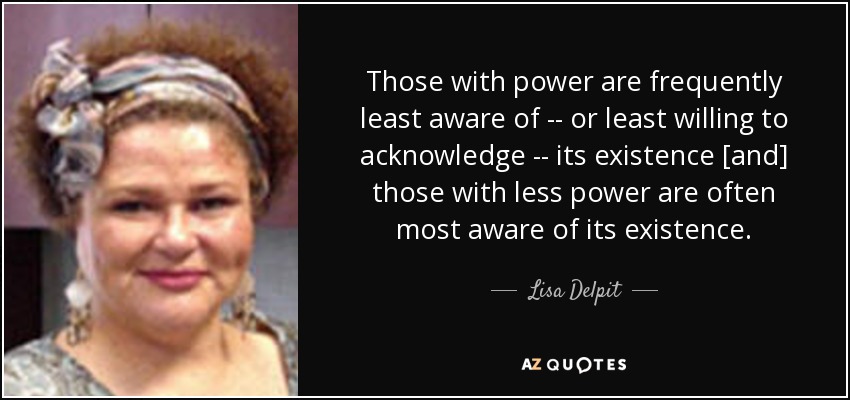
"The Culture of Power" is a main theme of the author's reading. What stood out to me is her point #5: "Those with power are frequently least aware of- or least willing to acknowledge- its existence. Those with less power are often more aware of its existence. " This is interesting to me, as when I first started teaching, I wondered why students misbehaved as I was the one who gave them their grades. I did think that I was in a position of power. I think that I may have even said this to a few students out of frustration when I didn't have as much teaching experience as I do today. I would not say this today. The author does state that this point has "seldom been addressed." I do agree with the text with "the power of the state in enforcing compulsory schooling." It is interesting how the author refers to "progressives" and "liberals" when making her points, including her quote that liberals "seem to act under the assumption that to make any rules or expectations is to act against liberal principles."
(End of Text)
A point that the author makes in the later part of the reading is with indirect communication. She states that direct communication is better. A provided example is with the East Indian interviewee, verses what you might say to a 10 year old to "turn the radio down". I find an interesting point is how the author states that a poor parent may say to a teacher, in response to when a teacher may be questioning the parenting, is "that's the school's job". The author states that if these parents were in a position of power, that they would in fact transmit these "codes" to their children. This is a classic example of when teachers are frustrated that they have no or limited response from a student's family, for example in a case when a teacher is trying to inform a parent about a student's continued misbehavior or disengagement in class, and a parent's response is that it is somehow the school's or the teacher's fault. Part of this may be a defense mechanism, but perhaps it is rooted deeper than this. The parents feel that they have limited power. The teachers feel that the parents should do a "better job" with parenting. This is a circle that I assume many teachers feel. The author quotes that child centered approaches are needed. I do agree with this philosophy, we tend to call it student centered in school. Delpit continues to provide an example of a doctoral student who was frustrated by their professor's approach in that they wanted the students to read and grade each other's papers as part of a writing course. This doctoral student stated that they weren't learning anything, and were there to learn from the teacher. I have heard this argument from students in my math classes on occasion. When redirected or told the student that they need to complete work, a reply may be something like "you haven't taught anything". As a teacher, this reply can cause a bad reaction. Sometimes I may try to remind the student that I did teach and provide notes on this. Or a better reaction that I have tried is something like, "Well, let's go over this now", which may bring the emotion out of the situation and be more effective. It is enlightening that this "process approach" utilized by teachers may appear to students as "doing nothing" and not teaching, as mentioned in this week's reading. The author states that the teacher should not be the only "expert" in the classroom. Per the author, "to deny students their own expert knowledge is to disempower them". This section continues that in an example of the primarily process-oriented writing class for black students, E.V. Siddle found that the intervention that produced the most positive changes in the students' writing was a '"mini-lesson" consisting of direct instruction, however, the second highest number of positive changes was a subsequent student-centered conference with the teacher. Delpit continues with the argument that black teachers are more direct with their instructions, for example, they will tell students to "Put those scissors on the shelf" verses questions by the "middle-class townspeople" teachers, such as asking "Is this where the scissors belong?". I know I have used this style in my classes, and as a parent, use both styles. The author continues that Middle-class parents are likely to give the directive to a child to take his bath as "Isn't it time for your bath?". This is understand by both the parent and child that this is actually a directive. Asking questions is also a method is sales. I am not sure if the author has done research on this or not. I have been in sales, including in insurance sales. Part of the training in sales is instead of asking a prospect if they want to meet for an appointment, to ask them what time works better for them, and to give them 2 choices ("Would 4 or 7pm work better for you?). I also see this in Facebook Reels where a car dealer's F&I salesperson asks questions to the prospect when trying to sell them an extended warranty, particularly when handling objections. The difference here is that the salesperson may ask the customer if they can ask them a question prior to proceeding ("May I ask you a question?). As a teacher transitioning from working in business and finance, particular after working in insurance sales from 2011 - 2012, I use questioning techniques as a teacher, in order to better engage my students, which is also a classroom management tool. The author continues that "Some members of middle-class cultures, by contrast, expect one to achieve authority of an authoritative role: The teacher is the authority because she is the teacher.". I agree with this premise, especially for newer teachers, until you realize as a teacher that sometimes in addition to being more direct (the "warm firm" approach), you also need to be able to influence your audience, the students. This correlates to what is provided in the reading, as a complaint of a black male student that the teacher couldn't "control the class". The reading concludes "that students must be taught the codes needed to participate fully in the mainstream of American life...and about the power relationships they represent". The author herself points out that she has been reminded by many teachers, that the most skillful at educating black and poor children, need to have both the "skills", and "process" approaches, which I also state in this blog that I do.
Argument Statement:
The main argument of this reading is that the struggle of academic students of color are often caused by cultural miscommunication, and not lack of ability, due to the power imbalances between predominately white teachers and minority students. It explores that dynamics between power, race, and cultural miscommunication that impacts students of color.
(A.I. Prompt: Other People's Children: Cultural Conflict in the Classroom)
Additional Personal Thoughts, Connections, and Reflections:
The main argument of the reading with that students of color are impacted negatively by cultural miscommunication, along with power imbalances between white teachers and minority students, hits home with me, since I am a white teacher with a large percentage of minority students. In one of the previous charter schools that I worked at City on a Hill in New Bedford, MA (which no longer exists), the "CEO" of the charter network, who is Black, told us once at an orientation that we shouldn't try to be "White Saviors" as teachers. I recall that I wasn't sure how to take this comment. I and others didn't get into teaching to be "saviors". In fact, I got into teaching in 2012, after working in an insurance sales job that I did not only find not fulfilling, I felt stress and anxiety as I was on a commission only structure, so if I didn't sell, I didn't make any money that week. During August 2012, my family and I went on a 10 day mission to volunteer at a rural school in a village in Amagaro, Kenya, that was approximately 7 miles from the Uganda border, near Mount Elgon. We did this as a partnership between my church, Church of Our Saviour in Somerset, MA, and North Elementary School also in Somerset, where my sons attended at the time, and with our connections in Kenya. We fundraised and volunteered. I had never taught before, but was leading small groups in Kenya with my oldest son who was going into the 6th grade at the time, and I was asked to lead a group of students outside. We started out with our introductions, and since they knew English (they were generally around my sons age so between 10 and 12), we could communicate in English, as they learn English in school, and also Swahili and their local dialect. They also taught us some words in Swahili, including how to say "pass" as in passing the soccer ball (they refer to soccer as football). Later in the week, we (the North Elementary students), and their students all played soccer together, and they also worked in the classrooms together. It was truly a collaborative experience. Some of the students had previously corresponded as part of a pen pal program that had been established prior to the trip. So when I hear the term "savior" with an implied negative connotation, I do not take that lightly, and am in fact offended. So seeing that the main argument is that minority students are impacted negatively by "White" teachers, is not what I signed up for by deciding to make a career change to education from business. I do want to learn from this and be mindful of what I can do to improve this for my students, however. In fact, as I am writing this, I saw the horrible news that a school was destroyed in Iran, and a hotel was bombed in Dubai. We stayed at a hotel in Dubai on our way to Kenya.
Of all the readings and videos that we have covered in class to date, this was the first one that I really found some issue with. In my opinion, this is overgeneralized. Again, this is based on my own personal experience, which I know that is one of the main arguments that this author herself makes. She doesn't like to be told that "based on research" these are the findings, when it is not her own personal experience. With an additional resource that I located from Harvard University, (link) Delpit "observed that many progressive educators emphasized process over skills, an approach that disadvantaged many students", she argued. Educators should teach students of color and students from low-income households the rules of the “culture of power,” including the dominant discourse of white middle-class Americans, she wrote, because “to act as if power does not exist is to ensure that the power status remains the same”.
I find this approach to be controversial as she states that you shouldn't emphasize process over skills. This is somewhat contradictory as we often state that it is the process or "system" that is in place. Systematic racism comes to mind as a prime example of a framework that is steeped in oppression. Also, Delpit mentions in the additional resource that I quoted above that educators should teach the "culture of power". As a math teacher, I would not be comfortable with this. This somewhat sounds like the highly controversial "Critical Race Theory" that is disparaged in the media.
In watching with the author's 2012 key note speech (YouTube link below), I do agree that teachers need to build relationships with their students. It is not just about the subject matter and tests.
Technology, Links, Other Texts, References, and Additional Connections:(Note: I used A.I. to create some of the hyperlinks automatically, through the Blogger application.)
https://newlearningonline.com/literacies/chapter-5/delpit-on-power-and-pedagogy
Keynote by Lisa Delpit (Teaching Tolerance 2012)
https://www.gse.harvard.edu/hgse100/story/visionary-scholar-and-reformer
https://www.facebook.com/ProdPrep/videos/do-you-sell-fi-and-cars-listen-to-rewatch-and-save-this-quick-guide-to-increasin/731313646693154/



Hi Darryl!
ReplyDeleteYour point about Delpit's observation that "black students do not multiply — they add or subtract" really stood out to me as well. As a fellow middle school math teacher, this is something I see often in my own classroom. Repeated addition is such a common approach for students who haven't fully internalized multiplication, and it made me think about how we as teachers respond to that. Do we immediately try to "correct" it, or do we recognize it as an asset? It connects back to the idea of asset-based thinking we explored in last week's reading. Rather than viewing repeated addition as a weakness or gap, it could be seen as a foundation to build from. I really enjoyed our blog post!
Thanks Giana. I appreciate your compliment and comment that you also see this in your math classroom. Even if students don't say this, I can tell many are hesitant, whether it's middle school or even in an Algebra 1 class in high school. Today, we were reviewing exponents with a number with a decimal to a power (6.2 squared) as part of an equation, and one student was paired up with another showing how to do multi-digit multiplication with decimals. Most won't admit that they don't know how to do the long multiplication algorithm, but some will.
DeleteWow so many things I want to talk with you about in this post. As I said on someone else's blog, the first time I read Delpit, I felt so called out when I realized that I was, in fact, the very well-intentioned, liberal, white educator that Delpit was critiquing here. I still am. I just read the whole room differently because of Delpit's culture of power model. And I see things that I might not have seen before... like the white savior dynamic that (I believe) has the potential to keep all the power hierarchies in place. I hope you will raise many of these issues in class so we can talk about them!! (ps check out Delpit's newer book, Multiplication is For WHite People https://rethinkingschools.org/articles/multiplication-is-for-white-people-an-interview-with-lisa-delpit-4/)
ReplyDeleteThanks Dr. Bogad. I just read the interview with Lisa Delpit via the link that you sent me. This book looks quite interesting, especially since I teach math. I will definitely bring this up in class. Thanks for your feedback!
ReplyDelete